
Wiggly Example露
The Wiggly example shows how to animate a widget using
QBasicTimerandtimerEvent(). In addition, the example demonstrates how to useQFontMetricsto determine the size of text on screen.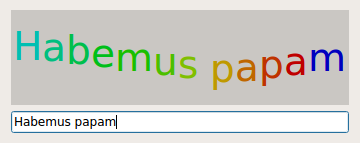
QBasicTimeris a low-level class for timers. UnlikeQTimer,QBasicTimerdoesn鈥檛 inherit fromQObject; instead of emitting atimeout()signal when a certain amount of time has passed, it sends aQTimerEventto aQObjectof our choice. This makesQBasicTimera more lightweight alternative toQTimer. Qt鈥檚 built-in widgets use it internally, and it is provided in Qt鈥檚 API for highly-optimized applications (such as embedded applications).The example consists of two classes:
WigglyWidgetis the custom widget displaying the text in a wiggly line.
Dialogis the dialog widget allowing the user to enter a text. It combines aWigglyWidgetand aQLineEdit.We will first take a quick look at the
Dialogclass, then we will review theWigglyWidgetclass.
Dialog Class Definition露
class Dialog : public QDialog
{
    Q_OBJECT

public:
    explicit Dialog(QWidget *parent = nullptr);
};
The
Dialogclass provides a dialog widget that allows the user to enter a text. The text is then rendered byWigglyWidget.
Dialog Class Implementation露
Dialog::Dialog(QWidget *parent)
    : QDialog(parent)
{
    WigglyWidget *wigglyWidget = new WigglyWidget;
    QLineEdit *lineEdit = new QLineEdit;

    QVBoxLayout *layout = new QVBoxLayout(this);
    layout->addWidget(wigglyWidget);
    layout->addWidget(lineEdit);

    connect(lineEdit, &QLineEdit::textChanged, wigglyWidget, &WigglyWidget::setText);
    lineEdit->setText(tr("Hello world!"));

    setWindowTitle(tr("Wiggly"));
    resize(360, 145);
}
In the constructor we create a wiggly widget along with a
line edit, and we put the two widgets in a vertical layout. We connect the line edit鈥檚textChanged()signal to the wiggly widget鈥檚setText()slot to obtain the real time interaction with the wiggly widget. The widget鈥檚 default text is 鈥淗ello world!鈥�.
WigglyWidget Class Definition露
class WigglyWidget : public QWidget
{
    Q_OBJECT

public:
    WigglyWidget(QWidget *parent = nullptr);

public slots:
    void setText(const QString &newText) { text = newText; }

protected:
    void paintEvent(QPaintEvent *event) override;
    void timerEvent(QTimerEvent *event) override;

private:
    QBasicTimer timer;
    QString text;
    int step;
};
The
WigglyWidgetclass provides the wiggly line displaying the text. We subclassQWidgetand reimplement the standardpaintEvent()andtimerEvent()functions to draw and update the widget. In addition we implement a publicsetText()slot that sets the widget鈥檚 text.The
timervariable, of typeQBasicTimer, is used to update the widget at regular intervals, making the widget move. Thetextvariable is used to store the currently displayed text, andstepto calculate position and color for each character on the wiggly line.
WigglyWidget Class Implementation露
WigglyWidget::WigglyWidget(QWidget *parent)
    : QWidget(parent), step(0)
{
    setBackgroundRole(QPalette::Midlight);
    setAutoFillBackground(true);

    QFont newFont = font();
    newFont.setPointSize(newFont.pointSize() + 20);
    setFont(newFont);

    timer.start(60, this);
}
In the constructor, we make the widget鈥檚 background slightly lighter than the usual background using the
Midlightcolor role. The background role defines the brush from the widget鈥檚 palette that Qt uses to paint the background. Then we enlarge the widget鈥檚 font with 20 points.Finally we start the timer; the call to
start()makes sure that this particular wiggly widget will receive the timer events generated when the timer times out (every 60 milliseconds).void WigglyWidget::paintEvent(QPaintEvent * /* event */) { static constexpr int sineTable[16] = { 0, 38, 71, 92, 100, 92, 71, 38, 0, -38, -71, -92, -100, -92, -71, -38 }; QFontMetrics metrics(font()); int x = (width() - metrics.horizontalAdvance(text)) / 2; int y = (height() + metrics.ascent() - metrics.descent()) / 2; QColor color;The
paintEvent()function is called whenever aQPaintEventis sent to the widget. Paint events are sent to widgets that need to update themselves, for instance when part of a widget is exposed because a covering widget was moved. For the wiggly widget, a paint event will also be generated every 60 milliseconds from thetimerEvent()slot.The
sineTablerepresents y-values of the sine curve, multiplied by 100. It is used to make the wiggly widget move along the sine curve.The
QFontMetricsobject provides information about the widget鈥檚 font. Thexvariable is the horizontal position where we start drawing the text. Theyvariable is the vertical position of the text鈥檚 base line. Both variables are computed so that the text is horizontally and vertically centered. To compute the base line, we take into account the font鈥檚 ascent (the height of the font above the base line) and font鈥檚 descent (the height of the font below the base line). If the descent equals the ascent, they cancel out each other and the base line is atheight()/ 2.QPainter painter(this); for (int i = 0; i < text.size(); ++i) { int index = (step + i) % 16; color.setHsv((15 - index) * 16, 255, 191); painter.setPen(color); painter.drawText(x, y - ((sineTable[index] * metrics.height()) / 400), QString(text[i])); x += metrics.horizontalAdvance(text[i]); } }Each time the
paintEvent()function is called, we create aQPainterobjectpainterto draw the contents of the widget. For each character intext, we determine the color and the position on the wiggly line based onstep. In addition,xis incremented by the character鈥檚 width.For simplicity, we assume that
horizontalAdvance(text) returns the sum of the individual character advances (horizontalAdvance(text[i])). In practice, this is not always the case becausehorizontalAdvance(text) also takes into account the kerning between certain letters (e.g., 鈥楢鈥� and 鈥榁鈥�). The result is that the text isn鈥檛 perfectly centered. You can verify this by typing 鈥淎VAVAVAVAVAV鈥� in the line edit.void WigglyWidget::timerEvent(QTimerEvent *event) { if (event->timerId() == timer.timerId()) { ++step; update(); } else { QWidget::timerEvent(event); }The
timerEvent()function receives all the timer events that are generated for this widget. If a timer event is sent from the widget鈥檚QBasicTimer, we incrementstepto make the text move, and callupdate()to refresh the display. Any other timer event is passed on to the base class鈥檚 implementation of thetimerEvent()function.The
update()slot does not cause an immediate repaint; instead the slot schedules a paint event for processing when Qt returns to the main event loop. The paint events are then handled byWigglyWidget鈥榮paintEvent()function.
漏 2022 The Qt Company Ltd. Documentation contributions included herein are the copyrights of their respective owners. The documentation provided herein is licensed under the terms of the GNU Free Documentation License version 1.3 as published by the Free Software Foundation. Qt and respective logos are trademarks of The Qt Company Ltd. in Finland and/or other countries worldwide. All other trademarks are property of their respective owners.