
QAccelerometerReading露
The
QAccelerometerReadingclass reports on linear acceleration along the X, Y and Z axes. More鈥�

Synopsis露
Functions露
Detailed Description露
QAccelerometerReading Units露
The scale of the values is meters per second squared. The axes are arranged as follows.
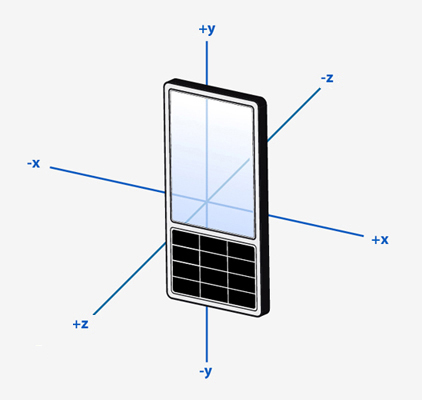
A monoblock device sitting at rest, face up on a desk will experience a force of approximately 9.8 on the Z axis (ie. towards the roof). This is the proper acceleration the device experiences relative to freefall.
- class PySide2.QtSensors.QAccelerometerReading(parent)露
- Parameters:
parent 鈥�
PySide2.QtCore.QObject
- PySide2.QtSensors.QAccelerometerReading.setX(x)露
- Parameters:
x 鈥� float
Sets the acceleration on the X axis to
x.See also
- PySide2.QtSensors.QAccelerometerReading.setY(y)露
- Parameters:
y 鈥� float
Sets the acceleration on the Y axis to
y.See also
- PySide2.QtSensors.QAccelerometerReading.setZ(z)露
- Parameters:
z 鈥� float
Sets the acceleration on the Z axis to
z.See also
- PySide2.QtSensors.QAccelerometerReading.x()露
- Return type:
float
This property holds the acceleration on the X axis..
The scale of the values is meters per second squared.
See also
QAccelerometerReading Units
- PySide2.QtSensors.QAccelerometerReading.y()露
- Return type:
float
This property holds the acceleration on the Y axis..
The scale of the values is meters per second squared.
See also
QAccelerometerReading Units
- PySide2.QtSensors.QAccelerometerReading.z()露
- Return type:
float
This property holds the acceleration on the Z axis..
The scale of the values is meters per second squared.
See also
QAccelerometerReading Units
漏 2022 The Qt Company Ltd. Documentation contributions included herein are the copyrights of their respective owners. The documentation provided herein is licensed under the terms of the GNU Free Documentation License version 1.3 as published by the Free Software Foundation. Qt and respective logos are trademarks of The Qt Company Ltd. in Finland and/or other countries worldwide. All other trademarks are property of their respective owners.